

.png)
What's Up? November 2025
Each month I highlight a number of interesting astronomical events and sights which can be viewed with the naked eye. Here we go for November - Jupiter makes a fine appearance and there is still time to see a comet and the Leonid meteor shower peaks this month.
Planets
Mercury
During the last few days of the month Mercury will emerge pre-dawn in the south western sky - tough to spot but possible!
Venus
Best to view during the first half of the month as a bright morning object - you can't miss it! Later in the month it will be in the murk of the horizon.

Mars
We have to wait until next summer to view our red neighbour.
Jupiter
The king of all planets is in the constellation of Gemini this month and will be shining brightly in the eastern sky. It begins the month as a morning object and gradually transitions to an evening object as the month progresses.
A waning gibbous moon passes east of Jupiter on the 9th and 10th of the month.
By the end of the month Jupiter will be rising around 7pm and will be well placed to observe from about 10pm throughout the night. It will be very bright!

Saturn
The ringed planet is well placed for observation in the south eastern sky as soon as darkness falls.
As the month progresses the observing time reduces so go for it now!

Leonids Meteor Shower
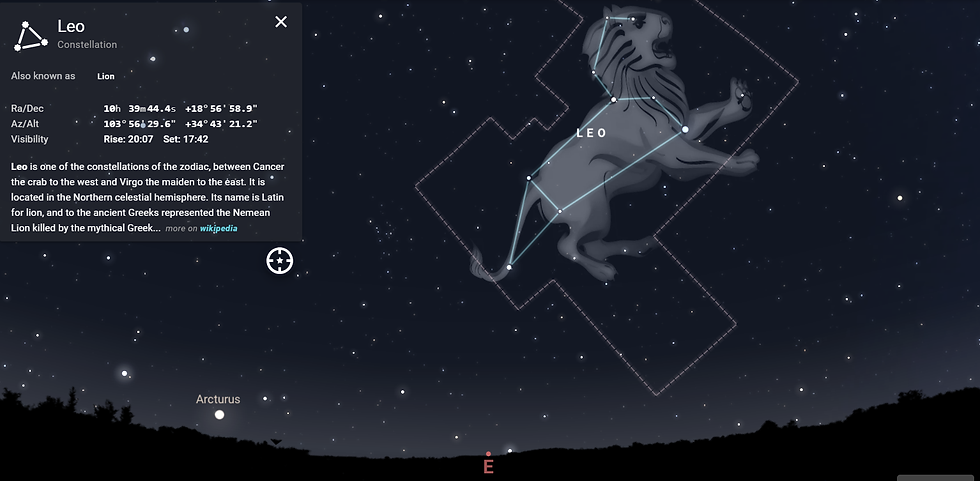
Each November, Earth passes through the dusty trail left by Comet Tempel-Tuttle, giving rise to one of the year’s most anticipated celestial displays — the Leonid meteor shower. Named for the constellation Leo, from which the meteors appear to radiate, the Leonids are known for their fast, bright streaks and occasional outbursts that light up the sky with hundreds of meteors per hour.
In 2025, the Leonids will peak around November 17–18, when observers under dark, moonless skies might see 10–15 meteors per hour. Though not a storm year, the Leonids’ swift, graceful trails — often tinged with green or blue — make them a favourite among stargazers.
How to observe them:
Timing: The best viewing is after midnight and before dawn, when Leo climbs higher in the east.
Location: Find a dark, open spot away from city lights. The fewer artificial lights around, the more meteors you’ll see.
Preparation: Bring a reclining chair or blanket, dress warmly, and allow your eyes 15–20 minutes to adjust to the dark.
Technique: You don’t need binoculars or a telescope — just look up and take in as much of the sky as possible.
Patience is key. Meteors come in bursts and lulls, but give yourself at least an hour beneath the stars, and you’ll almost certainly see several bright streaks cross the heavens — fleeting reminders of the cosmic debris that connects Earth to a wandering comet.
Comet C/2025 A6 (Lemmon)
About the comet
Comet C/2025 A6 (Lemmon) was discovered on 3 January 2025 by the Mount Lemmon Survey in Arizona.
It is a long-period (non-periodic in practical terms) visitor: its inbound orbital period is about ≈ 1,350 years, and after this passage around the Sun it's estimated at ≈ 1,160 years.
It passed its closest approach to Earth on 21 October 2025 and reaches perihelion (closest to the Sun) around 8 November 2025.
During its appearance it has shown a greenish coma/tail (from diatomic carbon emissions) and has been quite a good target for binoculars and cameras.
In short: this is a once-in-many-hundreds-of-years opportunity.
When & Where to Look (UK, November 2025)
While the prime viewing window was earlier (late October), there is still a chance to spot it in early November from the UK. Key details:
From early November the comet will be moving into the constellation Ophiuchus, low in the western evening sky.
According to charts for 8 November 2025 the comet’s position is given as RA ~ 16h 54m Dec ~ -08° 57′.
Its elongation (angle away from the Sun) is dropping, which means it will be increasingly lost in evening twilight.
Viewing tips:
Go out after sunset, ideally 30-60 minutes after, look toward the western horizon, but don’t wait too long — the comet will set sooner as the twilight deepens.
Find a location with clear western horizon, minimal light pollution, and a good open view (e.g., countryside, coast).
Use binoculars initially (7× or 10×) to sweep the area. The comet may appear as a faint, fuzzy greenish patch. A small telescope will help for tail structure.
Note that as November progresses the comet is getting lower and fainter; early November is the best bet. After perhaps mid-November it will fade into twilight.
Dress warmly, allow eyes to adjust to dark, and given the low altitude horizon look for atmospheric clarity too.
What to Expect
The brightness: At peak it was estimated around magnitude +3 to +4 under ideal dark skies, though from the UK with twilight and light pollution you might see it closer to +5 or +6 if conditions are good.
In November you may get a faint glimpse, or a binocular view rather than a striking naked-eye view, especially given the low altitude and twilight timing.
The tail may be subtle; the coma (fuzzy head) will be easier to spot than a long tail from UK latitudes as it sinks lower.
Why This Matters
Because of its long period (≈1,150 years post-perihelion), this is essentially your chance. It won’t return in our lifetimes!
It gives us a window into icy remnants of the outer Solar System; comets like this are time-capsules of primordial material.
GOOD LUCK!


Comments