

.png)
What's Up? October 2025
- Chris Baker
- Oct 3, 2025
- 3 min read
Each month I highlight a number of interesting astronomical events and sights which can be viewed with the naked eye. Here we go for October!
Venus and Jupiter are putting on a great show, especially for you early risers.
We have the Moon and the Pleaides star cluster in collision and a meteor shower!
PLANETS
Mercury
Not visible this month from the northern hemisphere
Venus
Venus puts on a mighty show for us this month - for those of you who are early risers - or very late to bed. Venus is a dazzling morning star, (magnitude -3.9) rising in the east at around 4:30am from London. The planet climbs to around 15 degrees before twilight begins to interfere with observing at around 6:45.
It is worth viewing early and mid month as by the end it becomes increasingly immersed in the twilight and you will miss its brilliance.
Note also in the pre-dawn sky on the 19th October a slender crescent Moon will lie close to Venus, making for a beautiful sight.
Venus and the crescent Moon around 6:30am on the 19th October

Courtesy of Stellarium
Mars
Out of view until next summer.
Jupiter
By mid-month Jupiter will rise in the east around 11pm and by 2am will be shining brightly around 30 degrees up. As the month progresses it will appear higher in the sky and at the end of October will be over 60 degrees by 5am - shining brightly in the south.
Jupiter on the 20th Oct around 6am in the south

Courtesy of Stellarium
Note the two stars appearing above Jupiter - they are the two prominent stars of the constellation Gemini. The upper star is Castor and the lower is Pollux. See if you can spot these too.
Also note Orion is still visible in the sky - all in all it is a stunning view!
Saturn
The planet puts on a good show all month. Mid month it rises (from London) around 30 minutes after sunset rising to a maximum of 30 degrees -but it can be seen for over 6 hours.
Saturn around 10pm mid month in the south
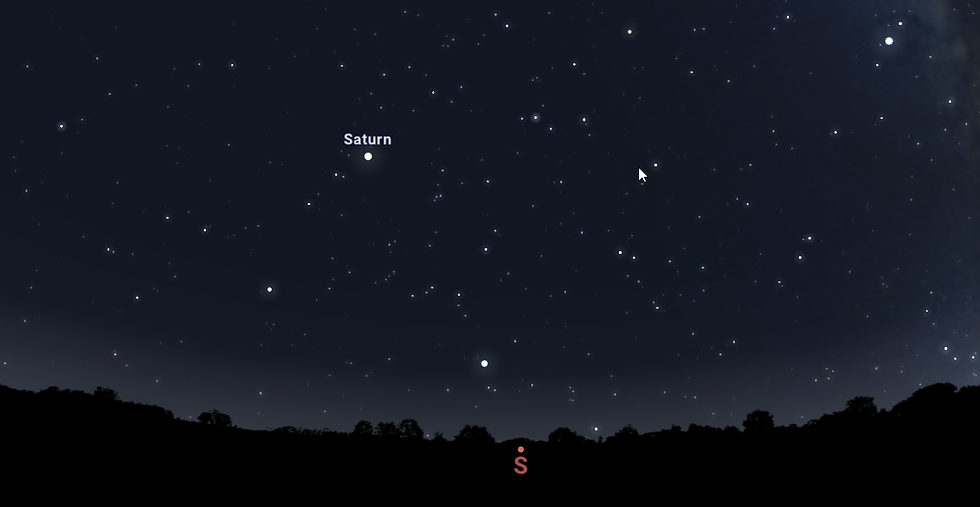
Courtesy of Stellarium
The Moon
I don't usually feature the Moon but this month it appears close to the bright star cluster Pleiades. On the nights of the 9th and 10th October the bright Moon (around 80-90%) will brush then mingle with the open star cluster. Normally it is difficult to see surrounding stars of a bright Moon but given the main stars of Pleiades are bright in themselves you should be able to see this pairing. It is worth a go!
Take a look in the east at around 10pm BST and they will be close. As the night progresses they appear closer. At 1am they are touching and by the early hours the Moon will be crossing the cluster.
The Moon and the Pleaides Star Cluster around midnight on the 9th October

Courtesy of Stellarium
Orionids Meteor shower
In August we have the Perseids meteor shower and in October the Orionids shower - it peaks from the 21st-23rd October.
It is a fine display and you can expect to see around 10-15 meteors/hour.
The Moon will be out of the way on those dates too making it easier to spot the meteors.
You will need to stay up past midnight though.
If you look in the direction of the bright red star Betelgeuse in the constellation of Orion - this will appear to be the Orionid radiant point.
The point will be around 30 degrees up and in the east.
The radiant point -Betelgeuse - around 1am on the 10th.

Courtesy of Stellarium
And don't forget to make a wish when you spot one!
Have a great month - looking upwards.
Chris Baker

Comments